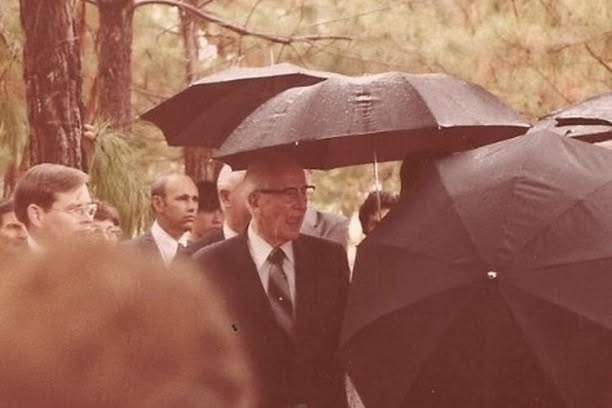


The beginnings of the Church in Brazil are recorded in the historical record book and in the branch records of the South American Mission, created in Buenos Aires in 1925. It is from those two books that I draw most of the information presented here.1
That year the First Presidency created the South American Mission and appointed Elder Melvin J. Ballard to serve as its first mission president, with headquarters in Buenos Aires, where several families who had been converted in Germany were living.
Elder Ballard came to South America with two other General Authorities, Elder Ray L. Pratt (president of the Mexican Mission and fluent in Spanish) and Elder Rulon S. Wels (fluent in German). Ever the missionary he had always been, Elder Ballard baptized and confirmed several people, handed out tracts in the streets of Buenos Aires, and taught people in their homes. He also dedicated the South American continent for the preaching of the gospel on 25 December 1925.
He remained a few months more, until the First Presidency sent a new president for the South American Mission: Karl Bruno Reinhold Stöof, a German who had migrated to the United States upon his conversion to the gospel.
President Stöof came to Brazil accompanied by Elder Stoddard. They arrived on 18 December 1927 at the port of Santos. Their purpose was to assess the possibilities for establishing missionary work, especially among German colonists. They also looked for a former German missionary who had emigrated to São Paulo, but did not find him.
After travelling by ship from Santos to São Francisco do Sul, they went on by train to Joinville, where they preached the gospel in the streets and at a public meeting attended by 142 people. President Stöof and Elder Stoddard also visited cities such as Blumenau, Jaraguá do Sul, São Bento do Sul and Indaial, where they preached the gospel. In Blumenau they sought out two German converts who had been ordained deacons, but discovered that one of them had died of typhoid fever some months earlier, and that the other, because of unemployment and the death of his friend, had returned to Germany.
Closing that first visit to Brazil, President Stöof spoke to an audience of 122 people in Joinville while waiting for his ship to depart, and returned to Argentina on 2 January 1928.
Several months later, Elders Heinz and Emil Anton Joseph Schindler became the first companionship assigned to serve in Brazil. They arrived in São Francisco do Sul on 17 September 1928, accompanied by President Stöof, and went straight on to Joinville. Working diligently from the first day, on 21 September they preached to an audience of more than 400 people in Joinville, using a slide presentation called “Utah and Its People.”
On Sunday 7 October the first regular Church meetings were held in Joinville, with Sunday School and Bible study. In those early days, opposition to the Church of Jesus Christ came chiefly from evangelical pastors, who devoted themselves to spreading falsehoods about the Church. Those efforts against the missionaries’ work, however, only helped increase attendance at the Sunday School classes held in Joinville.
Elder Schindler wrote to the members of his former German branch in Munich, telling them of his missionary experiences in Brazil. The South American Mission journal gives the following summary of his correspondence:2
He writes about his new field of labor in Joinville, which has 16,000 inhabitants. Ninety-five percent of these people speak German. They were born in Brazil, but there were no schools available for learning Portuguese. Joinville is a lovely little town, surrounded by large banana plantations. I had the opportunity of being present at the first Missionary Conference in Buenos Aires.
The Apostle Melvin Ballard organized the Mission in 1925 and there were only two German families; by 1928 they had 60 German members. He gave several slide presentations with Mission President Stöof as speaker. I had to overcome some anti-Mormon propaganda. Adventists and Catholics were giving anti-Mormon lectures; the elders, however, began giving lectures on 1 October 1928. Every time someone gave an anti-Mormon lecture, we were present. Some people were dissatisfied with what was said and after a time came to our meetings.
On Sunday 14 April 1929 the first baptisms in Brazil took place: Bertha Sell and her children Adele, Alice, Siegfried and Theodoro Sell, all confirmed the same day. Bertha and Theodoro were baptized by Elder Schindler, and Adele, Alice and Siegfried by Elder Heinz. Two children of the family were also blessed: Acilda and Eugen Sell. Only her husband and her eldest daughter were not baptized at that time. On the 15th, Elder Heinz completed his mission and returned home, leaving Joinville to board a ship in Rio de Janeiro and leaving Elder Schindler alone for some time.
An interesting detail about Sister Bertha Sell is that, a few days earlier, being ill, she had fallen to the ground in her garden after attending a meeting organized by the missionaries, Elders Schindler and Heinz. They went to her and administered a blessing of health to her. The day after the blessing, she sought out the missionaries and asked to be baptized.
Elder Frederick S. Williams, who was finishing his mission, was assigned to spend a few days with Elder Schindler in Brazil on his way home. Even so, Elder Schindler opened the work in one more city, where he found an evangelical congregation whose pastor had abandoned them, and they invited him to preach to them.
On 13 July President Stöof came once again to Brazil to help with the missionary work, and returned to Buenos Aires on 12 August.
On 19 September 1929 one more missionary was assigned to Brazil, Elder Gardner, to help with the great work being done among the German colonists in the state of Santa Catarina.
On Thursday 9 January 1930 six people were baptized in Joinville, and on Sunday 12 January another 5 people were baptized and 7 people were blessed. The following Sunday (19 January 1930) one more person was baptized in Joinville. The work seemed to be prospering with almost the same strength as in Buenos Aires.
On 11 June 1930 Brother Karl Otto died on his forty-third birthday. The funeral services were conducted with great dignity by the elders, with a powerful sermon delivered by Elder Schindler, and the presence of the Spirit was marked. It was the first funeral service held by the Church in Brazil. Many of those present said they had never witnessed so comforting and reverent a funeral. On 15 June, Oskar Otto, Karl’s son, was baptized by Elder Schindler.
On 30 June another companionship arrived to work in Joinville: Elders David J. Ballstaedt and Jack C. Cannon.
President Stöof organized the Joinville Branch, the first in Brazil, on 6 July 1930, with Elder Ballstaedt as its first president. On 29 July, President Stöof gave a lecture to more than 400 people defending the restored gospel against false accusations.
That year, 1930, Elder Schindler fell ill and had to leave Brazil for treatment in Buenos Aires. After recovering, he returned to Joinville and went on baptizing many people until he was released on 20 July 1930, after a little more than 33 months of service.
In 1932 he was called again by the First Presidency to serve in Brazil, where he remained until 1935, when the Mission was divided.
Of that period, Elder Schindler recalled:
I recalled the five months in which I had no companion and had to walk twenty-four miles every Sunday in order to hold meetings in two different places, or else close one meeting place, which I did not want to do. But the appreciation of those people, who at that time were not members of the Church, was rich payment for all the work. I shall never forget how, after some weeks of malaria fever, I returned to those people without realizing that the evidence of my illness was still visible. Taking both my hands, a friend said: “How much you must love us to come to us in your condition. Even so, we are happy and appreciate your interest in us and will never forget you. I am sure no other minister would have done so much. The Lord bless you.” Shortly afterwards he and his whole family joined the Church. It never occurred to me that I had done anything special. In truth, my feeling was one of joy in serving the Lord and my fellow men.
Because of the heavy persecution directed at the Church by leaders of other religions, the Church held a special meeting on 29 July 1930 at which the missionaries defended the doctrine of the Church. More than 450 people were present. Persecution in those first years was intense, but it ended up drawing more attention to the new Church that was taking root in Brazil.
On 1 August 1930, President Stöof, then on another journey through Brazil, went to the town of Rio Preto, where he found a family of German converts, the Lippelt family, who had arrived in Brazil eight years earlier. On 4 August 1930, President Stöof held a sacrament meeting with the family and ordained George Franz Lippelt to the office of teacher. In that small town, President Stöof held three public meetings, with 21, 23 and 35 people present. Before leaving Brazil, President Stöof visited Dr. Behm, a physician who had become interested in the Church after reading Church books.
In September 1930 seven more people were baptized in the Joinville Branch. On 26 September, President Stöof travelled to Brazil again, accompanied by his wife for the first time, and visited Rio Preto. On 4 October, President Stöof purchased a lot for a future Church chapel in Joinville. While the Stöofs were in Joinville, the Revolution of 1930 broke out. They were preparing to return to Buenos Aires, but their journey was interrupted by the Revolution; only on 30 October were they able to continue home.3
In March 1931, Elders Gardner, Drechsel and Cannon visited the village of Bananal at the request of the Pentecostal Church, and were received with great gladness by the people there, most of them poor.
On 30 July 1931 construction began on the first chapel in South America, in Joinville, whose branch was the hub of missionary efforts for all the surrounding towns and villages.
In 1931 Elders Schmidt and Ballstaedt travelled through several towns in the interior of Santa Catarina and Rio Grande do Sul. On that journey they found the Zapfs, a family of German converts, in Colônia Müller, near Rio Preto. The Zapfs had arrived in Brazil in 1913 but had lost contact with other members of the Church. They had not joined another religion, and only 18 years later did they have contact with the members again. That same day, 3 February, two children who had not been baptized in Germany were baptized, and five more children were blessed.
On 25 October 1931, President Stöof dedicated the Joinville chapel, considered at the time the first Church chapel in South America.
On 15 November the Estrada da Catarina Branch (today Dona Francisca) was organized, in a village near Joinville. Elder Drechsel was appointed branch president.
On 6 May 1932 the first youth organization of the Church was created, the “Jugendbund” (something like youth league or youth union). On 10 June 1932 preaching began in Jaraguá do Sul. Many people were baptized during that period in every place of preaching, just as many brethren were ordained to the Aaronic Priesthood and many children were blessed.
During that period, the Paulista Revolution of 1932 caused great concern for the safety of the missionaries, but since the conflict was concentrated in São Paulo, the work in Santa Catarina was little affected.
On 7 October 1932, 13 people were baptized and 3 children were blessed. On 8 October 1932 the first District Conference was held, opening with a Jugendbund meeting attended by 126 people. On the 9th, 86 people attended Sunday School in the morning, and 130 people were at the sacrament meeting in the afternoon.
On 28 December 1932 the Joinville Sunday School staged a play in three acts called “Die Zwergenpost” (“the dwarves’ post”). More than 500 people watched the performance, held in a public theatre.
Between April and June 1933, four more people were baptized, four children were baptized, and two brethren were ordained to the Aaronic Priesthood. During that period, Elder Phillip Guy Patterson began preaching the gospel in Porto Alegre, Rio Grande do Sul.
In October 1933 further baptisms were performed, along with a new Santa Catarina District Conference. On 11 October the first Relief Society meeting in the South American Mission was held, in the Joinville Branch. Toni Barsch was sustained as president, with Martha Otto and Margarete Buchli as counselors.
On 23 December 1933 the first baptisms in Porto Alegre were performed, of a family of three: Paul and Anne Kreil and their son Rudolf Paul Kreil.
On 29 December 1933, 30 children of the Joinville Branch staged a play, “Sneewittchen” (“Snow White”), before an audience of 1,100 people.
In March 1934, to mark the anniversary of the Relief Society, the musical “Der Weg zum Glück” (“The Road to Happiness”) was performed before an audience of 150 people.
On 25 March 1934 the Primary of the Joinville Branch was organized, with Toni Barsch and Olga Siedschlag-Schröder as teachers.
In Rio Preto the missionaries met with difficulties in establishing the Church, owing to a series of divisive attitudes among the members, as well as disciplinary actions that had to be applied for transgressions ranging from gossip to adultery. Church meetings there were even suspended for some weeks.
In May 1934 the civil marriage took place of Elder Sidney R. Cluff, who had been released in February, and Sister Martha Gertrud Brunhilde Stark, in Rio Negro, Paraná, where she lived with her parents. After receiving a blessing from Elder Loscher, they moved to the state of Utah. FamilySearch indicates that Sister Martha received her endowment on 16 October 1934 and that on the same day she and Sidney were sealed in the Salt Lake Temple. Hilda Stark Cluff, as she came to be known in the United States, was possibly the first person born and baptized in South America to receive the endowment and sealing in the temple.
Another miracle of healing occurred in Jaraguá, where, on 14 June, Brother Egon Müller received a blessing from Elder Loscher while hospitalized with a very grave case of septicemia, having lain unconscious in bed for 15 days. Days later he left the hospital.
On 10 June 1934 more than 300 people heard a presentation given by Elders Schindler and Patterson with slide projection.
On 15 June 1934, Max Zapf, Heinrich Blind and Georg Lippelt were appointed leaders of the Rio Preto group, owing to the absence of missionaries in the town. It was the first leadership made up entirely of local members.
On 10 June 1934, in Porto Alegre, Elders Schindler and Patterson held a lecture meeting attended by 300 people, after distributing more than two thousand invitations and publishing invitations in three of the city’s newspapers.
Also in 1934, a German-language newspaper called “Der Kompass,” in the city of Curitiba, state of Paraná, published an article titled “The Mormons Will Conquer the World.” One of the missionaries, Elder Peter Loscher, wrote a reply, but it was never published.
In January 1935, Elders Schindler and Stoll visited the city of São Paulo, where they met with members who had moved to that region. On 3 February, Elder Stoll baptized and Elder Schindler confirmed Elisabeth Wilhelmine Anna Busse, the first convert in the state of São Paulo, in the Cubatão region.
In 1935 the South American Mission was divided in two: the Argentine Mission and the Brazilian Mission. At that moment there were branches in only 4 cities in Brazil: Porto Alegre, São Paulo, Ipoméia and Joinville. After the division of the Mission, still in 1935, the Blumenau and Jaraguá do Sul branches were created.
Until then, Joinville had been the principal center of the Church in Brazil, where there were the most members and the largest district in the country. The Brazilian Mission established its headquarters in São Paulo, but the first Conference of the Brazilian Mission was held in Joinville on 26 May 1935.
- South American Mission manuscript history and historical reports, 1925 December-1935 August; Volume 1, 1925-1935; Church History Library, https://catalog.churchofjesuschrist.org/assets/0c8e82e9-5613-4cf7-a4a5-e6abff861f3d/0/0 (accessed 24 August 2026)
South American Mission manuscript history and historical reports, 1925 December-1935 August; Volume 2, Branch Histories, 1925-1935; Church History Library, https://catalog.churchofjesuschrist.org/assets/aa7c74a6-8402-4401-87c7-c8bbc91c50c8/0/0 (accessed 24 August 2026) ↩︎ - Account written by Emil Anton Joseph Schindler, found on FamilySearch. ↩︎
- A month earlier a similar revolution had taken place in Argentina, so that President Stöof and his wife lived through two notable revolutions in both countries. ↩︎
Translator’s note. This article was originally written in Portuguese by Renan Silva and published on this site as “Inícios da Igreja no Brasil: 1927-1935,” which can be read here. The Spanish and English versions were translated with Claude, by Anthropic.
How to cite this publication
APA (7th edition)
Silva, R. (2026, September 6). Beginnings of the Church of Jesus Christ in Brazil: 1927-1935. Legado de Promisión. https://legadodepromision.com/en/beginnings-of-the-church-in-brazil-1927-1935/
Chicago (bibliography)
Silva, Renan. “Beginnings of the Church of Jesus Christ in Brazil: 1927-1935.” Legado de Promisión, September 6, 2026. https://legadodepromision.com/en/beginnings-of-the-church-in-brazil-1927-1935/