
Many years ago, I remember going to the Bolognesi Ward chapel in Tacna and coming upon a group—mostly men—gathered for what seemed to be a talk. If memory serves, several of them still wore the missionary name tags of their youth. But what impressed me most was hearing Brother William Romero. Ever since I was a child I have loved my family’s stories and the accounts of how they came to know the Church: walking through the city and having people point out to me, “this happened here, that happened there.” That is why hearing the voice of someone who had lived through much older experiences was truly fascinating. I do not remember exactly everything he told us that day, but I do remember how captivated my mind was as I pictured, one after another, the scenes he described from his mission in the Andes Mission. And no wonder: he had been the first Peruvian missionary.
If there is one thing I keep in mind from my conversations with Brother Romero, it is his passion for historical accuracy. That is why that first time I heard him captivated me. Tacna, and Peru in general, is a deeply diverse country, rich in history. Yet for as long as I can remember, I have heard different versions of how the Church began and developed in Tacna and in Peru.
Many brethren—Church employees on training or work visits—brought one version; leaders and Area authorities shared another, very similar one in talks from the pulpit; in my family, however, people told a story somewhat different from those. But listening to someone who had lived through those times was a complete revelation, and it agreed with what my family used to tell—above all, it was a reason not to simply accept the versions that so often came from Lima.
With the historical rigor that characterized Brother Romero, I will take the risk of writing a brief account of some notable events in his life.
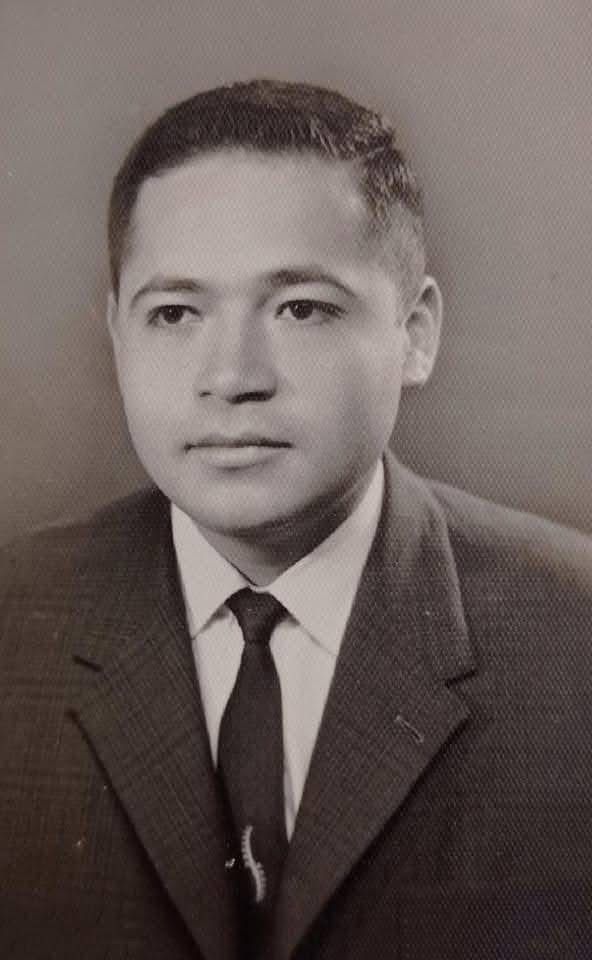
William Cipriano Romero Gómez was born on Friday, September 16, 1938, in the city of Moquegua. From a very young age he had to face adversity. His family moved to Lima because of the illness afflicting his father, but that period was marked by grief: his father died as a result of medical negligence, and shortly afterward they had to return.
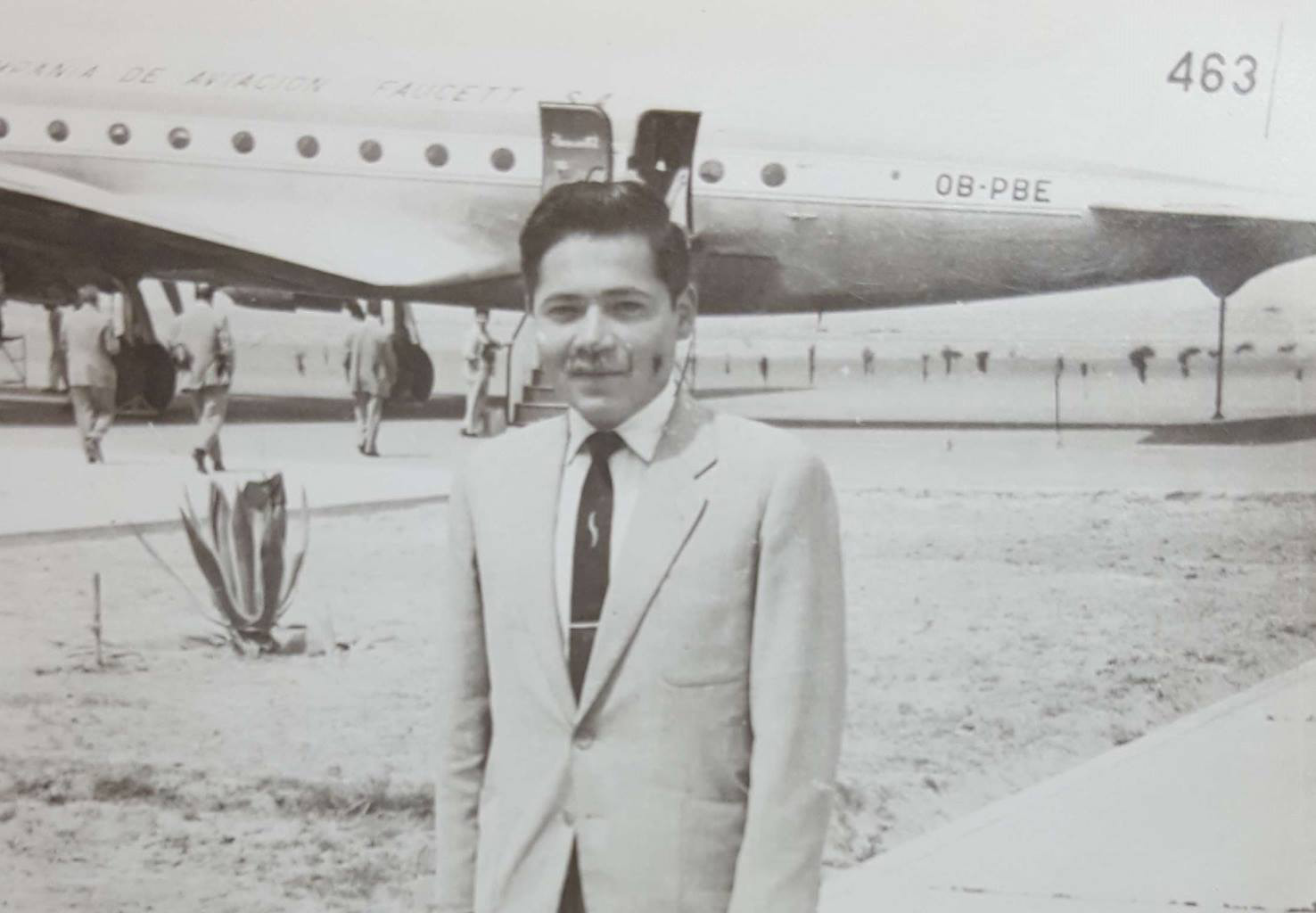
Seeking better educational opportunities, the family later moved to Tacna. Although they eventually decided to return to Moquegua, those early years wove into his life a close bond between the two cities, as if destiny kept carrying him from one to the other. As a young man he found work at the Toquepala mining center and, later, also on the ships that called at the port of Ilo. Thus, amid moves, hard work, and new beginnings, he made his way in a Peru still marked by the limitations and uncertain opportunities of the time.[i]
On February 16, 1959, while riding in a taxi to the port of Ilo, he spoke briefly with two missionaries. They told him they could visit him at his home in Tacna, and he agreed. A week later, on the afternoon of the 24th, they came to his house as missionaries of The Church of Jesus Christ of Latter-day Saints. They were Elder Spencer L. Brinkerhoff and Elder John Thomson. In his own words, he would write:
“The message was about the Trinity, which I understood and felt I already knew—but not so the appearances to Joseph Smith, which seemed very fantastic to me […] the Mormon missionaries gave me a Book of Mormon. To finish, they gave me a challenge: to find and know the truth, I had to fulfill three goals. The first was that I had to pray and ask whether these things are true; second, study to increase my knowledge; and third, attend their Church on Sundays, on the basis that ‘by their fruits ye shall know them.’ They gave me the address and the time of their meeting. I accepted the challenge.”[ii]
William was very religious and understood the message the missionaries shared with him, although he had reservations and doubts about some aspects. And so the missionaries began visiting him frequently in the days that followed. It seems this brought him some early difficulties.
“On one occasion my mother, upset, took the Book of Mormon from me and threw it onto the roof, which tore one of its pages. Because of that, I sometimes received the lessons at the foot of a pepper tree in the park behind the Tacna cathedral.”[iii]
On Sunday, March 1, he attended this church, which held its meetings in the main hall of what had been the Hotel Los Ángeles. It had surely been a hotel at some point, but by then it served as a residence for Southern Peru employees. Many of them were Church members from Mexico and the United States, although, for work reasons, several were probably already living at the mining camp. Perhaps that is why, when he arrived, he remembers seeing very few people.
Hotel Los Ángeles
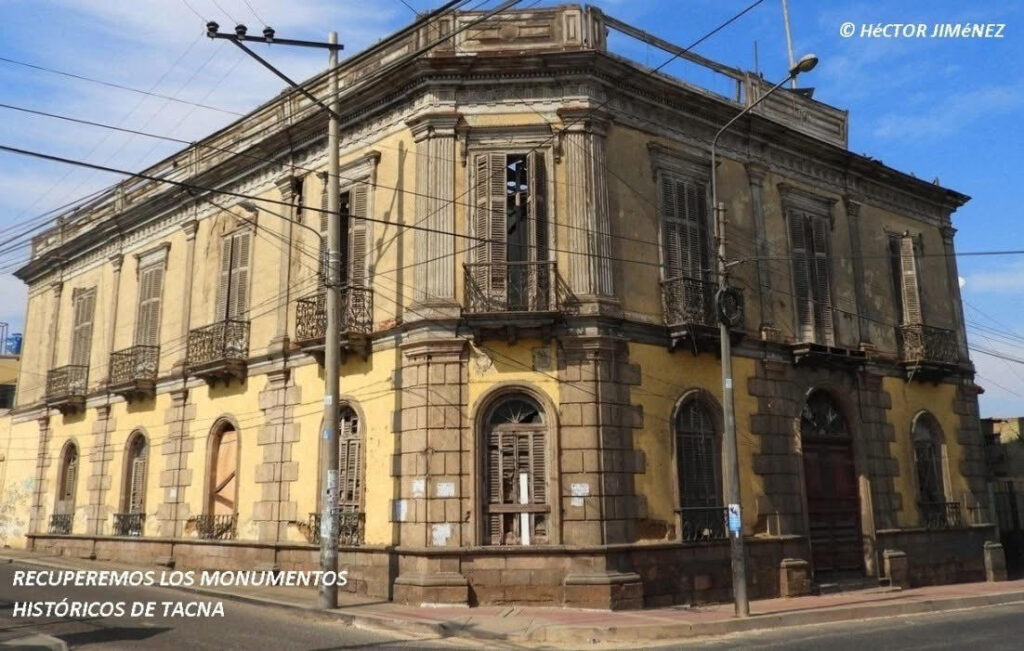
An iconic moment of this period, when he was just beginning to learn about the Church, was his participation in welcoming Elder Spencer W. Kimball at the airport when he arrived in Tacna on March 28, 1959. Because it was the Apostle’s birthday, the members, together with him and the party accompanying him, then went to the meeting place at the Hotel Los Ángeles, where they offered him a birthday cake, along with some keepsakes for all the visitors.
Dedication of the Toquepala chapel
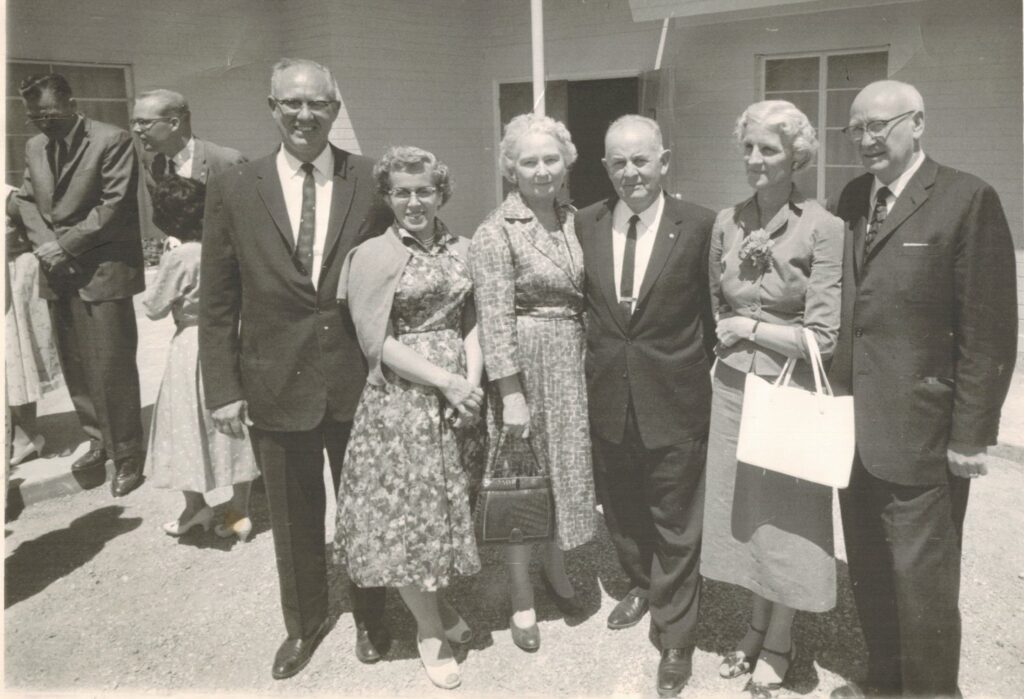
From left to right: Pres. & Sister Jenses, Elder & Sister Kimball, Pres. & Sister Williams.
This visit had a special purpose: the dedication of the Toquepala chapel, the first chapel in Peru. So, the next day, everyone traveled to Toquepala to take part in that event.
In those years, the Tacna, Toquepala, and Ilo branches, as well as the branch that existed in Lima, belonged to the Peruvian district under the jurisdiction of the Uruguayan Mission. The missionaries came from North America, and some of them often suffered health problems because of the poor sanitary conditions in the places where they served. That is what often happened to several of the first missionaries in Tacna, and it also became an opportunity for William.
Elder Brinkerhoff’s companion had fallen ill with hepatitis, which allowed William to accompany this missionary in his proselytizing work. William gave talks and assisted him on his visits. His first message was about prayer, and he would remember that Elder Brinkerhoff then told him that he “would be a good missionary.”
Interestingly, despite his active participation in the Church, William had not yet been baptized, because his mother would not give him permission and he had not yet reached the age of majority, which at that time was 21. [iv]
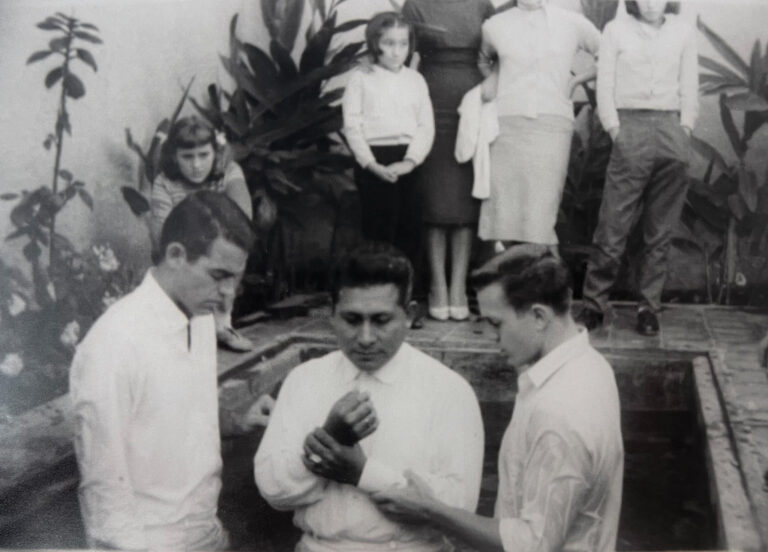
In September of that year, William went back to work in Toquepala, and finally, on November 13, 1959, he was baptized by Isaac Jarvis and confirmed by Hugh McClellan, brethren of the Toquepala Branch. At that time the branch president was Marion Robinson.
It was also at the end of 1959 that “Apostle Lee and his wife arrived in Toquepala; he was in charge of organizing the Andes Mission. He came accompanied by President Jensen and his wife, of the Uruguayan Mission; President Sharp and his wife also came, to preside over the new Andes Mission for Peru and Chile. Two missionaries accompanied them as well.”[v]
William, who had already briefly experienced what it was like to accompany the missionaries, even before being baptized, was called as a full-time missionary to serve in the recently created Andes Mission, thus becoming the first Peruvian to serve as a full-time missionary in that mission. And so, on September 30, 1960, he entered the mission field. At the Lima airport he was met by President Sharp, and he would write these recollections:
“He took me to the U.S. Embassy guesthouse located in Los Pinos, Shell, Miraflores. Four newly arrived missionaries were already there: Elders Hatch, Jones, Bateman, and Shoemaker. We left our luggage, and they took us to the mission offices on Lord Nelson Street.”
Andes Mission records
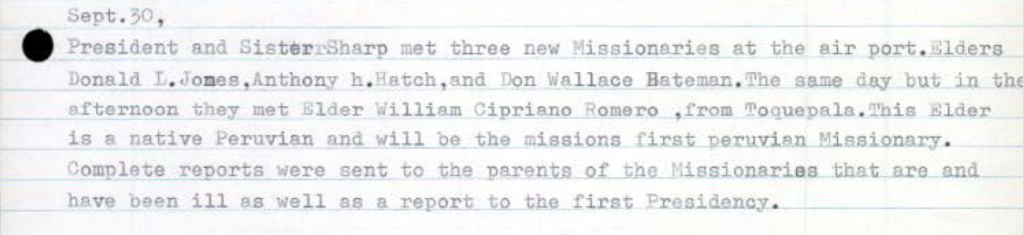
Transcription: Sept. 30, President and Sister Sharp met three new Missionaries at the air port. Elders Donald L. Jomes, Anthony h. Hatch, and Don Wallace Bateman. The same day but in the afternoon they met Elder William Cipriano Romero, from Toquepala. This Elder is a native Peruvian and will be the missions first peruvian Missionary.
Complete reports were sent to the parents of the Missionaries that are and have been ill as well as a report to the first Presidency.
Source: Andes Mission history, LR 6865 23, Church History Library.
Once in the mission field, he was ordained an elder and set apart as a missionary.
“On October 6, 1960, in Lima, I was ordained an elder by President James Vernon Sharp of the Andes Mission, during the missionary meeting held at the ‘Aurendez vu’ on Brazil Avenue. That same day and in the same place, I was set apart as a missionary by Apostle Joseph Fielding Smith, President of the Quorum of the Twelve.”[vi]
He served in Lima, in the Mariategui and Magdalena branches, and in Trujillo, where the work was just beginning.
Elders Romero and Pugmire on P-day
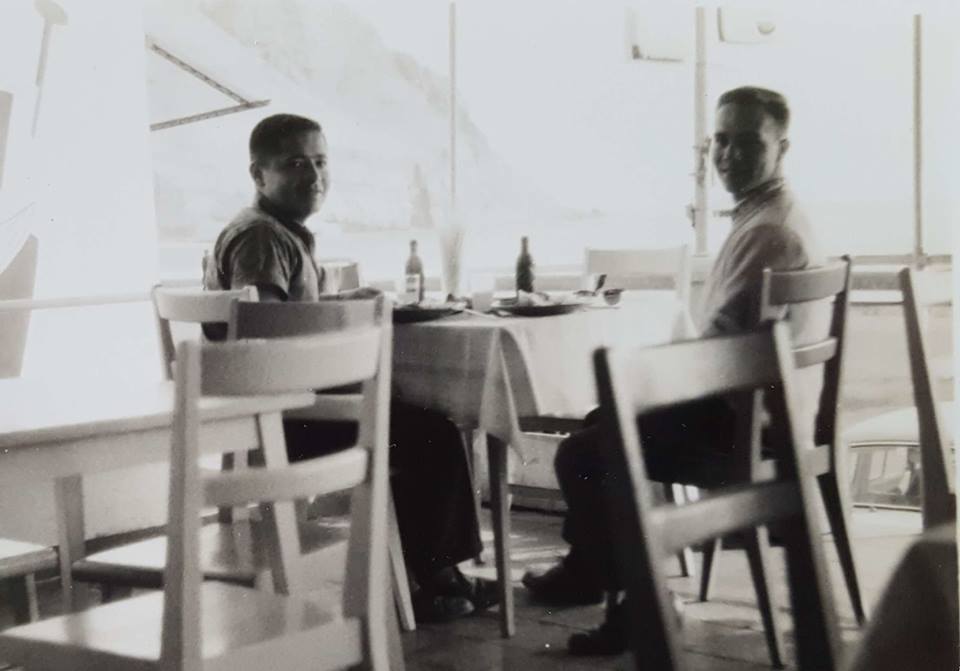
When he returned from his mission to Toquepala, he was called as president of the Toquepala II Branch, a Spanish-speaking branch, while the Toquepala I Branch was English-speaking. Apparently this was part of the vision that many of the early North American members had as Peruvians began to be baptized: that the branches in the country would gradually come to have local leadership.
Release as a full-time missionary

Transcription: September 28, 1962. Returned to Lima, Presidents Nicolaysen and Jones from Chiclayo. Interviewed Elder William Romero, who was honorably released today after a two year mission. He is a local Peruvian member. He was consuled in his responsabilities for leadership service in the Tacna branch after his return home.
Source: Andes Mission Manuscript LR 6865 2, Church History Library.
And although, owing to the circumstances of the time, the Toquepala branches ended up closing at the end of the 1960s, his service in the Church was invaluable. Some years later, the Toquepala branch was even organized again. Brother William’s efforts, in his capacity as a union leader, played an important role in the return of the missionaries and the reorganization of the branch, which over the years became part of the Alameda Stake. There, Brother William was later able to serve once again as branch president.
William Romero’s call as president of the Toquepala II Branch in 1963
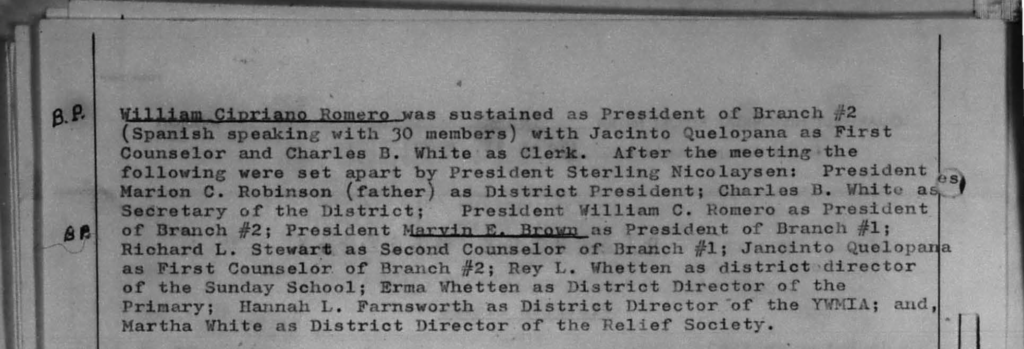
Transcription: William Cipriano Romero was sustained as President of Branch #2 (Spanish speaking with 30 members) with Jacinto Quelopana as First Counselor and Charles B. White as Clerk. After the meeting the following were set apart by President Sterling Nicolaysen: President Marion C. Robinson (father) as District President; Charles B. White as Secretary of the District; President William C. Romero as President of Branch #2; President Marvin E. Brown as President of Branch #1; Richard L. Stewart as Second Counselor of Branch #1; Jancinto Quelopana as First Counselor of Branch #2; Rey L. Whetten as district director of the Sunday School; Erma Whetten as District Director of the Primary; Hannah L. Farnsworth as District Director of the YWMIA; and, Martha White as District Director of the Relief Society.
Source: Andes Mission Manuscript LR 6865 2, Church History Library.
He married Nancy Vargas on October 30, 1982, and they had three children: Marco, Carolina, and Claudia.
In 2023 I had the opportunity to share a talk with him on the history of the Church in Tacna, at the invitation of the Granados Ward.
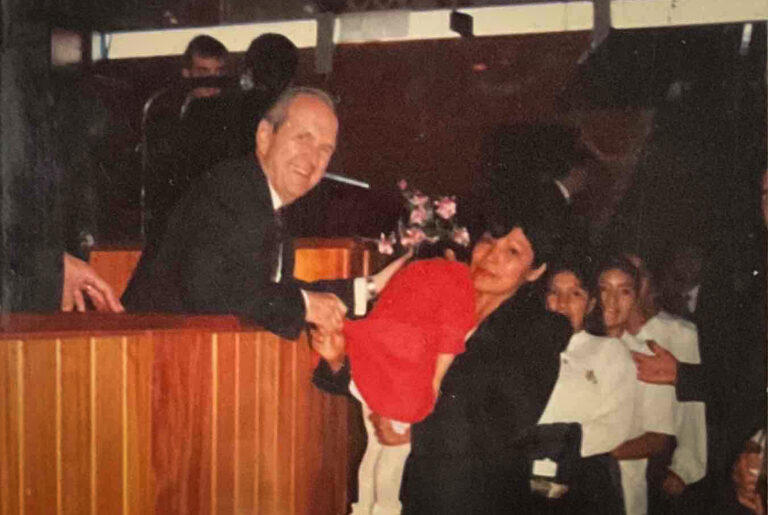
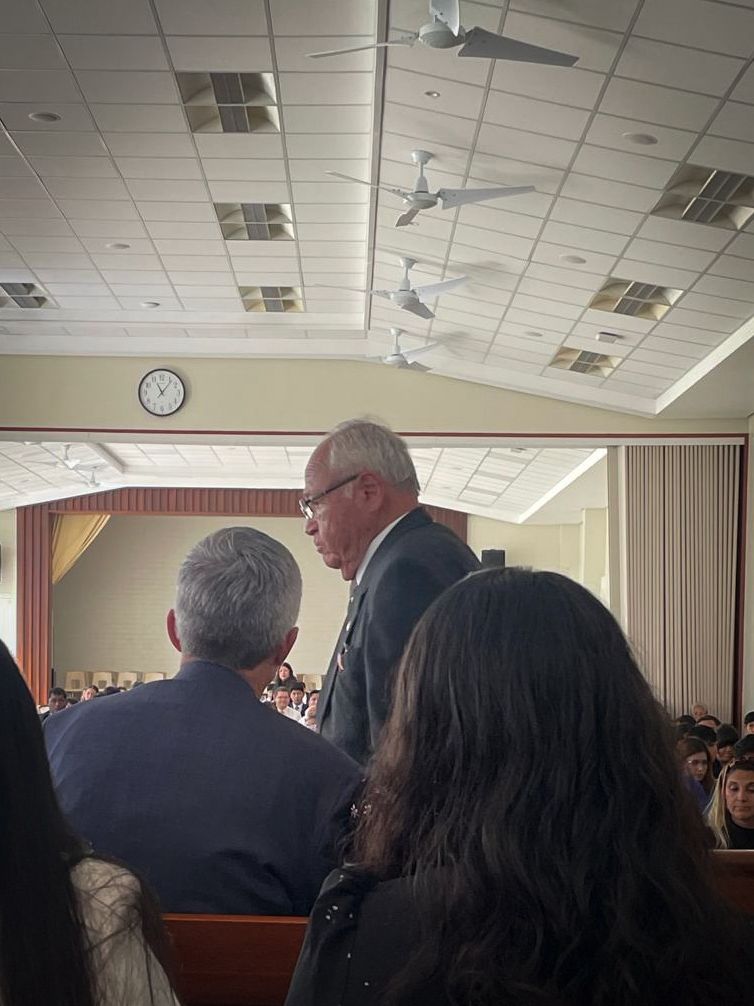
On July 28, 2024, during a Tacna Stake conference, he offered a prayer. I remember with great gratitude the words we were able to exchange.
Tacna Stake conference, 2024
He very kindly corrected some of the texts in which I was writing about episodes of his life for a book I am finishing. I loved sending him screenshots or photos of the documents I was finding, which further clarified my understanding of the history of the Church.
Personally, I am deeply grateful for his legacy: for his service as a missionary and for having, together with other pioneers, laid the foundations of a Church that today we can live and enjoy as we know it. I hold him in deep gratitude and respect for being one of the people who inspired me to keep researching and writing.
Sources cited:
[i] William Cipriano Romero Gomez, “William C. and Nancy R. Romero Interview: Lima, Perú, 2015 October 24. OH 8733,” Church History Library, 2015.
[ii] William Cipriano Romero Gomez, “Historial de William Romero (Autobiografía). OH 8733 ,” Church History Library, 2015, p. 3.
[iii] Romero Gomez, “Historial de William Romero (Autobiografía). OH 8733 ,” p. 4.
[iv] Romero Gomez, “Historial de William Romero (Autobiografía). OH 8733 ,” p. 4.
[v] Romero Gomez, “Historial de William Romero (Autobiografía). OH 8733 ,” p. 4.
[vi] Romero Gomez, “Historial de William Romero (Autobiografía). OH 8733”, p. 5.
Translator’s note. This article was originally written in Spanish by Marvin Josué Jiménez Viveros and published on this site as “William Romero: El legado de un pionero,” which can be read here. The English version was translated with Claude, by Anthropic.
How to cite this publication
APA (7th edition)
Jiménez Viveros, M. J. (2026, October 18). William Romero: The Legacy of a Pioneer. Legado de Promisión. https://legadodepromision.com/en/william-romero-the-legacy-of-a-pioneer/
Chicago (bibliography)
Jiménez Viveros, Marvin Josué. “William Romero: The Legacy of a Pioneer.” Legado de Promisión, October 18, 2026. https://legadodepromision.com/en/william-romero-the-legacy-of-a-pioneer/