
Introduction
Luis Abanto Morales (1923–2017) holds a special place in the musical and cultural history of Peru. Known as “El Cantor del Pueblo” (the People’s Singer), his voice became one of the symbols of Creole and Andean song, an emblem of pride thanks to compositions such as El Provinciano and Cholo Soy. From a young age he began an artistic journey that would take him from radio contests in the 1940s to international performances and, finally, to recognition as an Artistic Heritage of the Americas in 1987, granted by the Organization of American States (OAS).
However, the life of Luis Abanto Morales cannot be understood from an artistic perspective alone. His life and that of his family were profoundly shaped by his conversion to The Church of Jesus Christ of Latter-day Saints toward the end of the 1950s. The sources analyzed show a man who, in addition to establishing himself as a musical reference, played a leading role in the early years of The Church of Jesus Christ in Peru. These sources—which include Luis Abanto Morales’s own oral history, as well as documentary sources from the Church itself—are used in this article.
This article does not attempt an exhaustive analysis of his artistic career or a detailed biography. Its purpose is to give a brief account of his life, with special emphasis on his role as a pioneer of The Church of Jesus Christ of Latter-day Saints in Peru.
In that intersection of music and faith, identity and service, lies the richness of a figure whose life not only gave voice to the Peruvian people through art but also helped lay the spiritual foundations of a community of Saints in the making.
His life:
Childhood
Luis Abanto Morales was born on August 25, 1923, in Trujillo, La Libertad. However, his roots were in Cajabamba, a small town in Cajamarca where his parents, Víctor Abanto Calderón and Rosa Obdulia Morales Sánchez, came from.1
Luis’s childhood was soon marked by adversity. According to Luis Abanto Morales, when he was only nine years old he lost his father, and with that death everything changed. It was then that his paternal grandmother, Doña Melchora Calderón Altamirano, took him with her to Cajabamba to care for him.1
Life with his grandmother was hard, but she knew how to turn little into enough to live on. Luis remembered how they went around the hamlets with rag dolls made by his grandmother’s own hands: “We would go to the hamlets, and she made little rag dolls and [t]raded them [for] beans and lentils”2. Bartering seems to have been common in a place where poverty and adversity gave no respite.
In the midst of that austerity, his grandmother taught him a principle that became a moral compass. One day, seeing his schoolmates in new shirts, Luis asked why he could not have the same. His grandmother answered firmly: “They have their new shirts, but they’re all dirty, my [li]ttle son. The elegance of the poor is cleanliness, and you are nice and clean, so you are elegant” 2. That phrase—“the elegance of the poor is cleanliness”—stayed with him always as a reminder that dignity and elegance did not depend on wealth.
His school days in Cajabamba, at School 113 directed by the teacher Máximo Barrueto 1, were the days when Luis would discover his love of singing, although at the time he sang without any formal training. “Ever since I was little I liked to sing,” he said, and he attributed it to his father, who had played the concertina, an instrument similar to a bandoneon 2. In Cajabamba, the Christmas festivities offered the perfect stage: “In the provinces they celebrate a lot at Christmastime, they make nativity scenes, and I would sing certain little passages of Christmas music inside with them”2. These were small parts, barely a rehearsal for what was to come, but enough to kindle a vocation.
At around twelve or thirteen, Luis’s life changed course again. His mother, Rosa Obdulia, traveled from Lima to bring him back with her. “I must have been twelve when my mother went to Cajabamba to bring me to Lima,” he recounted 2. Another source states that he was thirteen when he finally left Cajamarca to settle in the capital 1. And various articles about his life give 1936 as the year Luis Abanto Morales traveled to the Peruvian capital. What is certain is that, at the beginning of his adolescence, his life took a new path in the city of Lima.
Youth and the beginning of his artistic career
The arrival of Luis Abanto Morales in Lima, at only twelve or thirteen, was not easy. The move from Cajabamba to the capital forced him to resume his schooling, which brought some academic difficulties. Then 1942 proved decisive. At only nineteen, Luis took part in a popular contest that opened the doors of the artistic world to him for good. “In 1942 there was a contest called ‘La canción de los barrios’ [The Song of the Neighborhoods]—that is, each neighborhood of Lima presented its singer, and at that time I represented the neighborhood of Lince and Lobatón here in Lima” 2, Luis would recall, and it was in that contest that the young man from the provinces stood out among the participants.
That victory changed everything. He would say: “In 1942 I was lucky enough to win that contest, ‘La canción de los barrios,’ and I started right away on Radio Lima for three months. In those days earning 100 soles was a fortune, so the prize was those 100 soles and a three-month contract with Radio Lima” 2
Radio opened a new world to him. There he met a man who would help him at this start of his artistic path: the pianist Filomeno Ormeño. “I met a great maestro… and I was lucky that he noticed me, and he took me to record eighty songs,” Luis recalled 2. In those years Peru still did not have high-quality recording studios, for “they didn’t record here yet; they recorded in Chile or Argentina, Buenos Aires.” 2
On returning from his first recordings, Luis joined a quartet called “Los Mensajeros del Perú,” who would leave their mark on this period. The group consisted of Osvaldo Niser on piano, Carlos Dávila, Felipe Coronel Rueda, and Luis himself. 2
He also contributed his own compositions to the repertoire. One of the best remembered was “Quiéreme” [Love Me], although the public knew it by its first line. He would recall this anecdote, saying: “I have a waltz that was also very popular at that time, which I titled ‘Quiéreme,’ but no one asked me for it by the name ‘Quiéreme’—they asked for it by how the song began (he sings) ‘paseando por el parque me fui…’. But people never asked for it by its name; nobody said to me ‘Quiéreme, Quiéreme’… people asked me for ‘paseando por el parque, paseando por el parque,’ imagine that… (he laughs).”2 Undoubtedly, even then, his style was unmistakable.
In the late 1940s, his artistic commitments took him abroad again. It was in Argentina, amid those tours and recordings, that destiny led him to meet María Esther Colina, the woman with whom he would share the rest of his life.
Meeting María Esther Colina in Argentina
At the start of the 1950s he was still in Argentina, and his companions had to return to Peru: “I stayed in Argentina, and [with] a Peruvian who played the piano, named Miguel Paz, … we formed a duo that we called ‘el dúo de la simpatía’ [the Charm Duo]”. 2
With the “dúo de la simpatía” they toured various Argentine provinces, and on one of those tours they reached San Luis, where Luis would meet María Esther Colina. He told it this way: “We arrived in San Luis, where my wife, María Esther, was a professor at the University of Cuyo… but she wasn’t my wife yet (he laughs). That’s where we met.” 2
The meeting was marked by an episode that would become a family anecdote: the fountain pen. During a performance by the Paraguayan harpist Félix Pérez Cardozo, a young professor asked to borrow a pen in order to request a song. Luis recounted that moment with humor: “At the time I thought my wife was one of the students in the group that was there, and it turned out she was their professor, and she was asking for a pen to request a song from Don Félix Pérez Cardozo, and I had a Parker 51 with a gold cap, and I lent her the pen, and then they called me away, I don’t know for what reason… and I didn’t know who was going to end up with the pen. [It was] a reason to visit María Esther afterward; I no longer cared about the pen, just about going to see [her] (he laughs).”2
What began as a kind gesture became the start of a relationship. Soon after, Luis met the Colina family: “Afterward I met my father-in-law, Benito Colina, who was the irrigation superintendent in Santa Rosa, in the province of San Luis,” he would recall2. The relationship quickly grew stronger and ended in marriage. Luis told it this way: “On December 24, 1951, we were married in Santa Rosa.”2
Luis Abanto Morales and María Esther
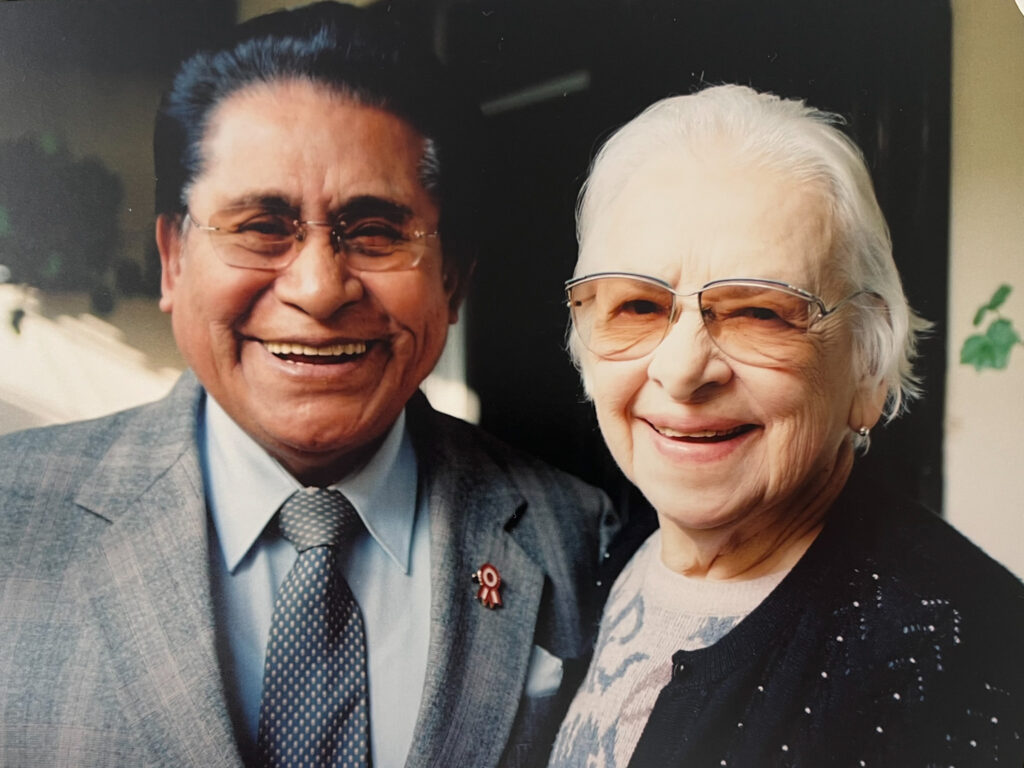
Luis Abanto Morales and his wife, María Esther, 2004, Lima, NEC.
Source: Curbelo, N. (2006). Perú: Investigación histórica. Vol. 2: Fotografías (Vol. 2). Harold B. Lee Library, Brigham Young University, Provo, UT. Family History, Religion and Philosophy. Call number: BX 8678.5 .C922p 2006 vol.2.
Conversion to The Church of Jesus Christ of Latter-day Saints
The faith story of Luis Abanto Morales and María Esther Colina began in Lima in the mid-1950s.
María Esther was the first to receive the missionaries. “When we lived in Lince, one day two young men came; one was Elder Isom, the other was Elder D[a]na, and they began talking to me and everything, and I loved it”2, María Esther recalled. Enthusiastically, she told her husband about that visit: “When Luis came home I told him: ‘Two young men came who are going to come back on such-and-such a date’… and that’s how we began”2
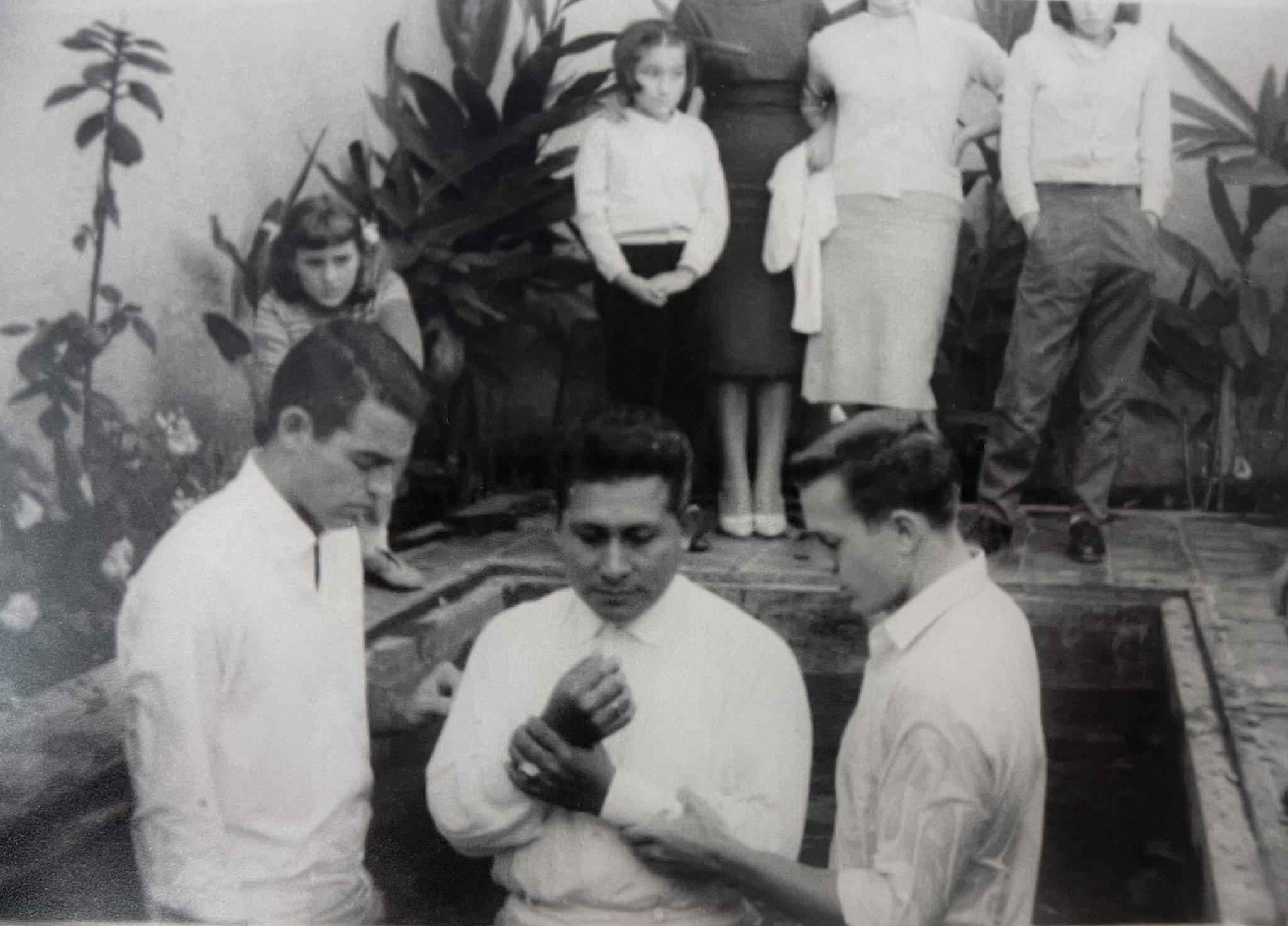
Soon both decided to be baptized; the date was June 6, 19592. Years later, in a talk commemorating the 50th anniversary of the Andes Mission in Peru, Luis specified: “Elder Ison baptized me and Elder D[a]na baptized my wife. That same year my four children, who had never been baptized in any church, were blessed, and I remember that while they were blessing Mary, who was only 6 months old, she pulled Brother Williams’s glasses off”3—he was the president of the Lima branch. Now members, Luis and María Esther began attending the Lima branch, which met in a house in Orrantia.
Baptism in Lima, the Abanto Morales family and others
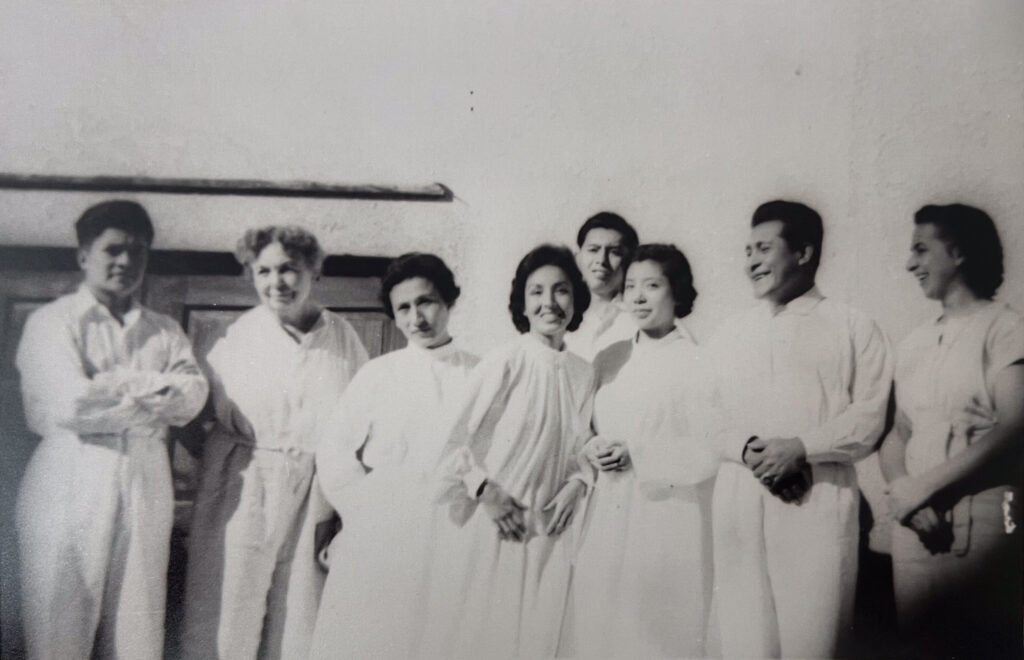
Baptism in Lima, the Abanto Morales family and others.
Source: Curbelo, N. (2006). Perú: Investigación histórica. Vol. 2: Fotografías (Vol. 2). Harold B. Lee Library, Brigham Young University, Provo, UT. Family History, Religion and Philosophy. Call number: BX 8678.5 .C922p 2006 vol.2.
Then Luis faced one of his first tests of faith: paying tithing. He told it frankly: “I said to myself: ‘Shoot… if I pay tithing I won’t be able to pay what I owe; better not to pay tithing,’ but I was in that indecision, I don’t know what made me want to cheat… I said: ‘No, let God’s will be done,’ and I took out… I paid my tithing.”2
The answer came immediately. “The next day a gentleman shows up and says: ‘Look, Mr. Abanto, I have…’—he told me an amount of money for those days—‘because I need you to take care of this matter of…’ At that moment I didn’t think about what he was saying; I thought about the miracle: I had nothing, and just then he comes to offer me money—more than enough. I paid what I had to pay and still had money left over.”2 That experience marked his life. “[He] always thought… ninety percent with God’s blessing is worth more than one hundred percent without it.”2
An especially significant moment came on November 1, 1959, when Apostle Harold B. Lee presided in Lima over the conference at which the Andes Mission was formally organized. For that occasion, Luis Abanto Morales and President Frederick S. Williams had prepared a special hymn: Williams wrote the lyrics and Luis the music. During the meeting, Luis performed La Misión de los Andes [The Andes Mission]. The official minutes record the song, performed by Brother Luis Abanto of the San Isidro Branch, with music by Luis Abanto and lyrics by President Frederick S. Williams. The song moved Elder Lee so much that he asked to hear it a second time, which the minutes also record.4
Song lyrics: La Misión Andina [The Andes Mission]
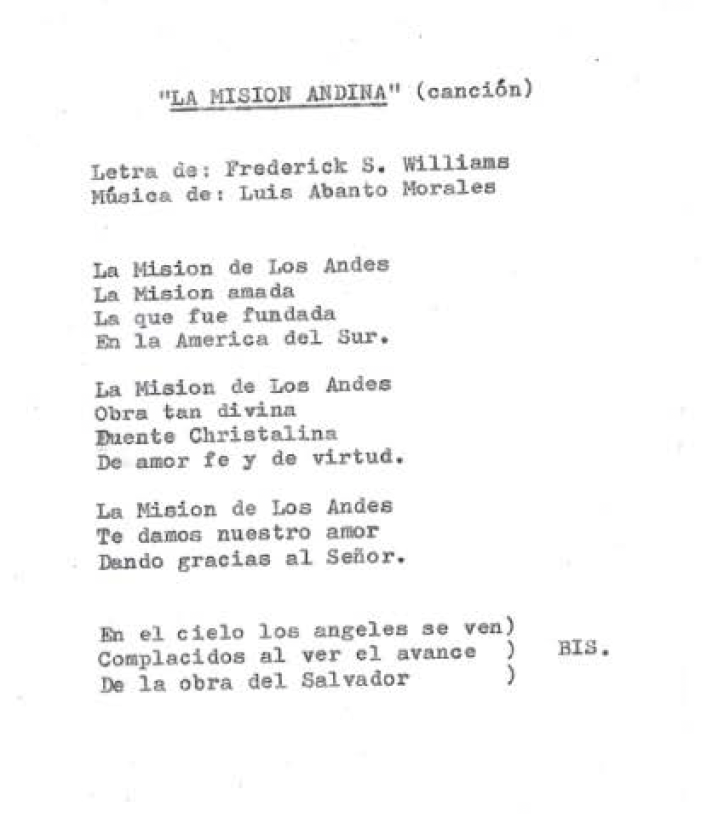
Source: Misión Andina. (1957). Andes Mission history, circa 1956–1962 – LR 6865 23.
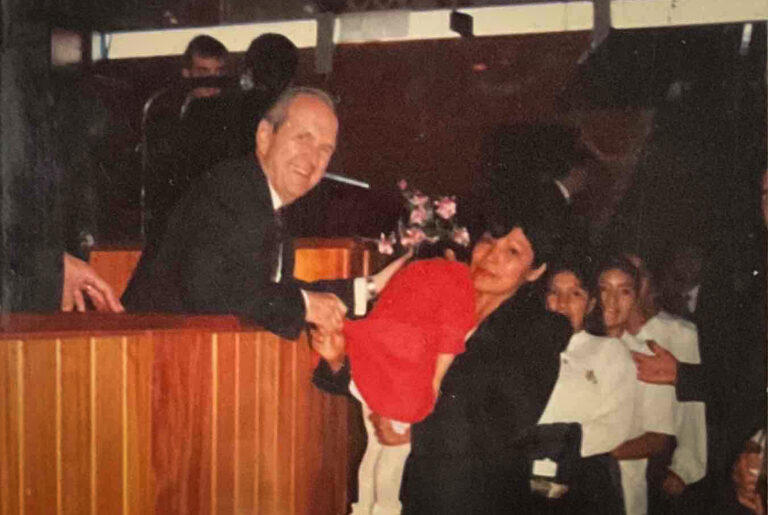
Luis Abanto Morales later recounted that, at the end of the session, the Apostle asked his family to stay and blessed him in a special way: “I had the honor of singing it twice at the request of Apostle Lee, who at the end asked my family and me to stay, and it was then that he gave me a very special blessing that made me feel comforted and loved by our Heavenly Father.”3
María Esther never forgot that moment. It stayed in her memory simply: “He blessed Luis so that he would keep singing like that all his life” 2. For both of them, these experiences would be of great value.
The young couple’s faith also showed itself in service. María Esther found an example in the wife of Brother Frederick S. Williams: “Sister Williams was the Relief Society president; she began to teach me, she was the one who taught me the most… and when she left, they called me as Relief Society president, which I loved, and we were very close with all the sisters there in Orrantia.”2
The 1960s brought much progress in the lives of Church members in Peru. In those years, construction began on the first chapel in Lima, the second in Peru. Luis Abanto Morales and María Esther Colina remembered those years as a time of sacrifice, service, and shared enthusiasm. As they put it: “the church was built, first the one in Limatambo; Luis worked there too, he would go and help there.”2
Luis Abanto Morales’s service in these years was not limited to music or to volunteer work on chapel construction. As early as January 24, 1960, he was set apart as supervisor of visiting teachers in the San Isidro Branch by President David Smith4. On April 22, 1961, Luis also took part in a social activity organized by the Mutual in the San Isidro Branch, to which all the Lima branches were invited. According to the record of the activity, the program included members such as Miss Mila Aguirre, Brother Abanto Morales, and other guests—television and radio stars in Argentina and Peru—who accompanied themselves in folk songs and dances.4
This decade also brought times of trial. On February 27, 1962, Luis was in an accident; the Church records note that Brother Luis Abanto Morales, the member who had sung at Sunday’s conference, was hit by a car and taken to the hospital.5 The next day, President James Vernon Sharp visited him to give him a blessing.5
Despite the difficulties, his service in the Church continued. On November 25, 1962, the record notes that Brother Luis Abanto was set apart as first counselor in the Barranco Branch.4 Like him, his wife worked in the Relief Society, helping with various activities. 2. María Esther remembered it with emotion: “In those days, well, there were the spiritual living lessons, the work we did, there were exhibits, sewing classes—I remember we did very lovely things”2. These activities strengthened the sisters, creating networks of friendship and shared work while contributing to the work of the Church. The Relief Society is perhaps one of the oldest women’s organizations in the world.
In the early years of the Church in Peru, Luis Abanto Morales took advantage of his constant artistic tours to help with missionary work. Whenever he arrived in a city, he would let his friends know that “two young North Americans” would soon be arriving and ask them to lend a hand. ““Two North American gentlemen are going to come here, and I want you to give them a hand… they’re going to look for a place because they are missionaries of The Church of Jesus Christ of Latter-day Saints, and so I want you to help them”—I didn’t tell them they were Mormons,” he recounted. In this way, in places such as Chimbote, Trujillo, Chiclayo, and Piura, he prepared hearts and contacts that made missionary work easier. Years later, he would receive with surprise and joy the news that some of the friends he had asked to help the missionaries had become members of the Church.2
As the years went by, Luis Abanto Morales saw in his posterity the confirmation of the promises of the gospel. Three of his children—Roland, Dorothy, and Mary—served as full-time missionaries, and later so did his grandchildren, in places as diverse as Chile, the United States, and Ecuador. “I am very happy that my grandchildren are active in the Church and have callings in the auxiliary organizations, and I am very grateful to our Heavenly Father for each and every one of His blessings”3, Luis would say when sharing his testimony at a meeting commemorating the 50th anniversary of the Andes Mission on November 29, 2009.
Abanto Morales family, 1956
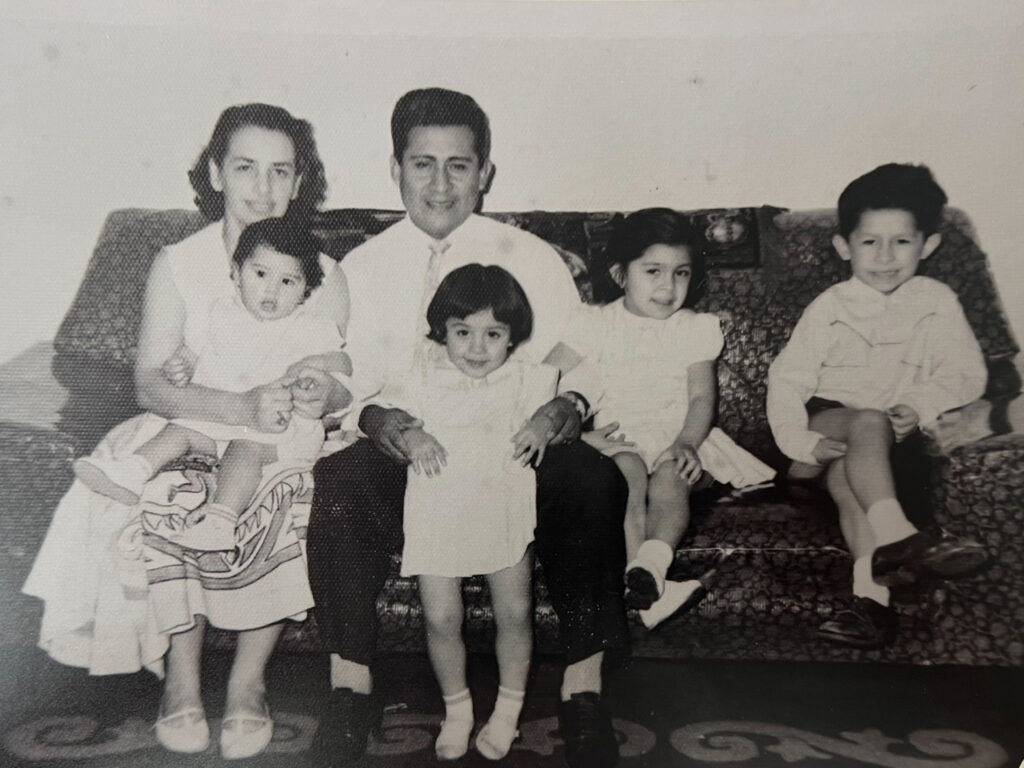
The Abanto Morales family, 1959. María Esther, Mary, Luis, Nancy, Dorothy, and Roland.
Source: Curbelo, N. (2006). Perú: Investigación histórica. Vol. 2: Fotografías (Vol. 2). Harold B. Lee Library, Brigham Young University, Provo, UT. Family History, Religion and Philosophy. Call number: BX 8678.5 .C922p 2006 vol.2.
Luis Abanto Morales died on June 14, 2017, leaving a legacy that transcended stages and generations. All of Peru bid him farewell as the singer of its deepest identity, the one who with Cholo Soy turned a wound into an anthem. “Cholo soy y no me compadezcas, que esas son monedas que no valen nada… nosotros los cholos no pedimos nada, pues faltando todo, todo nos alcanza”, he sang, with the serenity of one who knew that dignity is not measured in riches but in the hope that sustains the soul.
That song, which gave voice to the pain and struggle of the humblest, also reflected the faith that guided his life: trust in a God who sees each of His children beyond their social condition. That is why, when his voice fell silent in this life, it remained alive in the memory of a people who will keep listening to him as a witness that, even amid poverty and injustice, there is a God who turns suffering into strength and humility into greatness.
Sources cited:
- Curbelo N. Perú: Investigación histórica. Vol. 3: Publicaciones y documentos. Vol. 3. Buenos Aires, Argentina: Harold B. Lee Library, Brigham Young University, Provo, UT. Family History, Religion and Philosophy. Call number: BX 8678.5 .C922p 2006 vol.3.; 2006.
- Curbelo N. Perú: Investigación histórica. Vol. 1: Historias orales. Vol. 1. Buenos Aires, Argentina: Harold B. Lee Library, Brigham Young University, Provo, UT. Family History, Religion and Philosophy. Call number: BX 8678.5 .C922p 2006 vol.1.; 2006.
- La Iglesia de Jesucristo de los Santos de los Últimos Días. Falleció Luis Abanto Morales, reconocido cantante peruano [Internet]. Sala de Prensa – Noticias de La Iglesia de Jesucristo de los Santos de los Últimos Días. 2017 [cited September 19, 2025]. Available from: https://noticias.laiglesiadejesucristo.org/articulo/fallecio-luis-abanto-morales–reconocido-cantante-mormon?country=peru
- The Church of Jesus Christ of Latter-day Saints. Andes Mission manuscript history – Call number: LR 6865 2 . Salt Lake City, Utah: Church History Library; 1959.
- The Church of Jesus Christ of Latter-day Saints. Andes Mission history, circa 1956–1962 – Call Number: LR 6865 23. Salt Lake City, Utah: Church History Library;
Translator’s note. This article was originally written in Spanish by Marvin Josué Jiménez Viveros and published on this site as “‘Cholo soy, y no me compadezcas’: música y fe en la vida de Luis Abanto Morales,” which can be read here. The English version was translated with Claude, by Anthropic.
How to cite this publication
APA (7th edition)
Jiménez Viveros, M. J. (2026, October 18). ‘Cholo soy, y no me compadezcas’: Music and Faith in the Life of Luis Abanto Morales. Legado de Promisión. https://legadodepromision.com/en/cholo-soy-music-faith-life-luis-abanto-morales/
Chicago (bibliography)
Jiménez Viveros, Marvin Josué. “‘Cholo soy, y no me compadezcas’: Music and Faith in the Life of Luis Abanto Morales.” Legado de Promisión, October 18, 2026. https://legadodepromision.com/en/cholo-soy-music-faith-life-luis-abanto-morales/